 Most people don’t start from scratch when dealing with hair loss. They try something—whether that’s a shampoo, a serum, or a more structured routine. In many cases, there is some initial improvement. Hair may feel stronger, the scalp condition improves, and shedding can even slow down.
But over time, progress often levels off. There’s no dramatic reversal, but no meaningful improvement either. This is the point where many begin to question whether their approach is actually working.
What External Treatments Actually Do
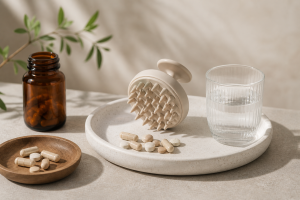 Most external approaches—such as scalp massage, topical products, or devices—focus on improving the condition of the scalp itself. They aim to increase circulation, support a healthier environment, and encourage follicle stimulation.
These factors are important, and in many cases necessary. Consistent scalp massage, for example, or the use of tools designed to provide more even and controlled stimulation—such as the Growband—can help bring structure and consistency to this part of a routine.
However, there is a limit to how far external methods alone can take things.
Where Progress Tends to Stall
Hair growth does not depend solely on what is happening at the surface. It also depends on what the body is able to supply to the follicle. This includes adequate nutrient availability, overall health, and the body’s ability to maintain normal hair growth cycles.
If that internal support is lacking, the follicle may not respond as expected, regardless of how consistent the external routine is. This is often where progress begins to slow—not because the approach is wrong, but because it is incomplete.
A More Complete Approach
Rather than relying on a single method, a more balanced approach considers both sides of the process. External methods help improve the scalp environment and provide stimulation, while internal support helps ensure that the follicle has the resources it needs to sustain healthy growth over time.
These two elements are not alternatives to each other. They work best when combined as part of a consistent, long-term routine.
Putting This Into Practice
In practical terms, this often involves maintaining regular scalp stimulation—either manually or with the help of a device—alongside a structured hair care routine. At the same time, attention is given to internal support, particularly in cases of longer-term or gradual thinning.
For some, this includes introducing a targeted supplement designed to support hair health over time, rather than relying on short-term solutions.
Bringing it all together
 In practice, this means maintaining regular scalp stimulation—whether manually or with a dedicated device—while also addressing what’s happening beneath the surface. It’s about consistency on both fronts.
For many people, this is where a targeted supplement comes in. A product like HR23+ isn’t a quick fix; it’s there to provide the long-term nutritional support follicles need in order to respond properly to external treatments, particularly in cases of ongoing or gradual thinning.
The bottom line
If your progress has levelled off, it’s rarely because your routine is wrong—it’s usually because it’s incomplete.
You may have already improved the environment. But without the right internal support, there’s only so far that can go.
Results tend to come when both sides are addressed together—when the internal and external are working in tandem.